
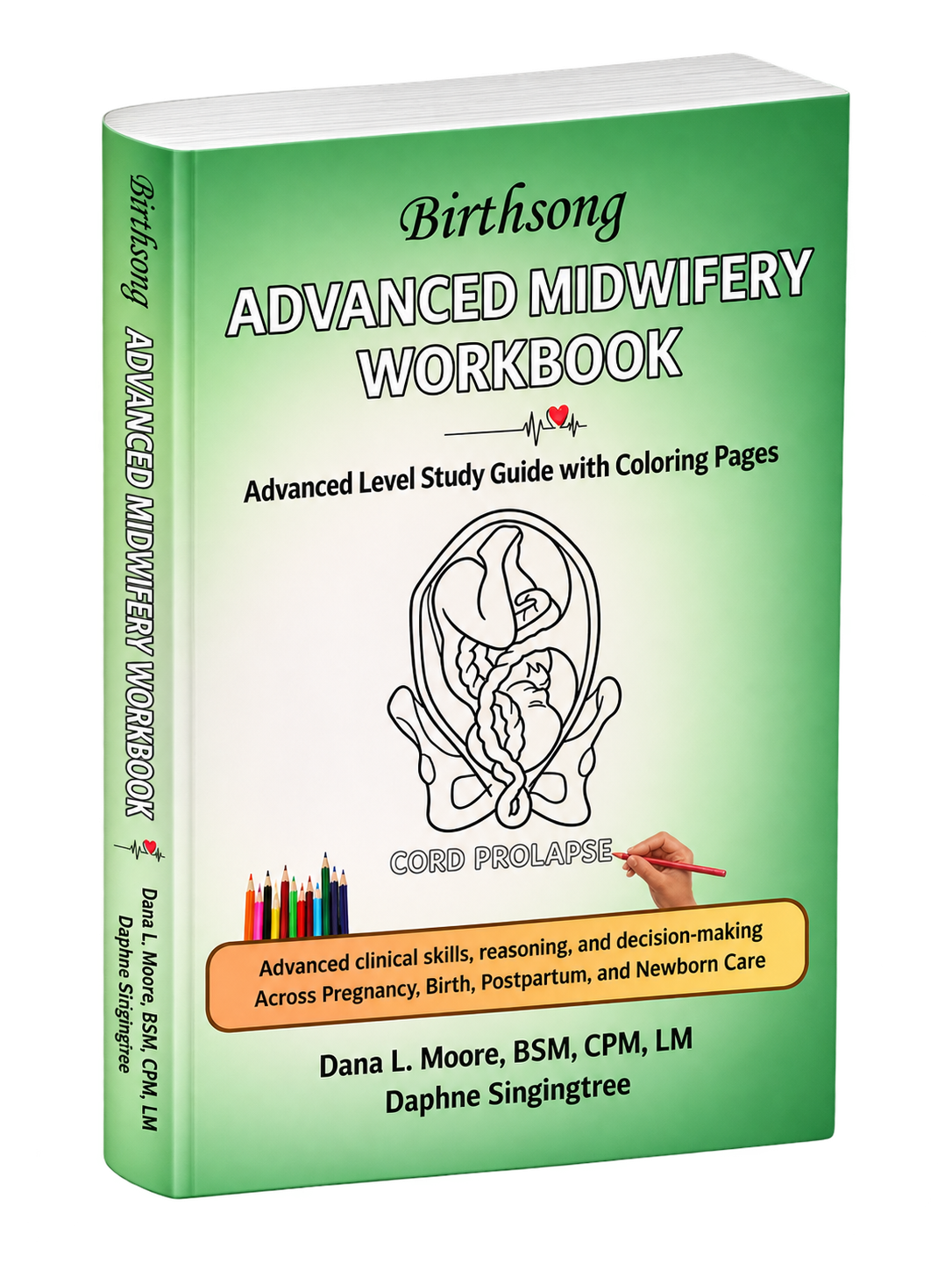
Birthsong Advanced Midwifery Workbook.

Print Edition: Now Accepting Preorders!
Publication date: January 31, 2027.
Expected shipping: February 2027.
Payment is collected when you preorder.
Exclusive Preorder Bonus:
Preorder the printed Advanced Workbook and receive a 50% discount coupon by email for the printed Birthsong Basic Level Midwifery Workbook, 7th Edition. The Basic Level Workbook is available now and ships separately when purchased.
Digital PDF Edition:
Available February 1, 2027. Not available for preorder.
| Weight | 2.5 lbs |
|---|---|
| Format | Digital PDF, Print |
The Birthsong Advanced Midwifery Workbook is designed for student midwives advancing beyond foundational education and practicing midwives seeking to strengthen their clinical knowledge, critical thinking, and decision-making skills. Written by experienced midwifery educators Dana Moore and Daphne Singingtree, this workbook builds on the foundational learning introduced in the Birthsong Midwifery Workbook, 7th Edition. The advanced workbook emphasizes clinical reasoning, recognition of complications, appropriate consultation and referral, emergency preparedness, and professional responsibility. It encourages midwives to connect knowledge with practical judgment while maintaining individualized, compassionate care.
What’s Inside the Workbook?
Advanced Clinical Knowledge and Skills
Explore more complex aspects of pregnancy, labor, birth, postpartum recovery, and newborn care, with attention to clinical assessment, risk recognition, and appropriate responses.
Clinical Reasoning and Decision-Making
Develop the ability to recognize patterns, interpret findings, consider possible complications, and make thoughtful decisions in changing clinical situations.
Emergency Preparedness
Strengthen emergency planning, team communication, consultation, transfer decisions, and practical response skills.
Professional Growth
Explore ethical practice, risk management, professional accountability, and the importance of sustaining personal resilience throughout a midwifery career.
More Than a Textbook: An Interactive Learning Experience
The Birthsong workbooks are designed for active learning. Rather than simply reading and memorizing information, students are encouraged to apply knowledge, analyze situations, and evaluate their own understanding.
Learning features include:
- Clinical case studies and decision-making exercises
- Anatomy and clinical coloring pages
- Matching, sequencing, and other interactive exercises
- Clinical pearls and practical reminders
- Recognition of red flags and developing complications
- Reflection and critical-thinking activities
- Chapter self-assessments with an answer key for independent study
These activities support classroom learning, midwifery apprenticeships, clinical education, and independent review.
Who Is This Workbook For?
- Advanced student midwives
- Practicing CPMs, LMs, and other midwives reviewing advanced clinical knowledge
- Midwifery educators and preceptors
- Midwifery schools and training programs
- Students preparing for advanced clinical responsibilities
- Midwives returning to practice or refreshing their knowledge
Preorder Information
Publication Date: January 31, 2027. Preorders are paid at the time of purchase and will ship when printed copies become available. Delivery dates may vary. Customers who preorder the Birthsong Advanced Midwifery Workbook through Eagletree Press will receive a coupon for 50% off one print copy of the Birthsong Midwifery Workbook, 7th Edition. The coupon may be shared with another student or midwife. The discount applies to the printed book only, not the digital PDF edition, and excludes shipping and applicable taxes. It cannot be combined with other offers.
About the Authors


Bulk Orders for Schools and Study Groups
Midwifery schools, preceptors, and study groups interested in ordering multiple copies are welcome to contact Eagletree Press directly.
Contact:
Eagletree Press
| Weight | 2.5 lbs |
|---|---|
| Format | Digital PDF, Print |
Only logged in customers who have purchased this product may leave a review.
Table of Contents
Select a chapter to view its topics.
Chapter 1: Clinical Reasoning and Decision-Making
- Pattern Recognition
- Differential Diagnosis
- Clinical Prioritization
- Risk Stratification
- Cognitive Biases
- Clinical Uncertainty
- Escalation of Care
- Decision-Making Frameworks
Chapter 2: Ethics and Professional Responsibility
- Midwifery Ethics
- Beneficence
- Nonmaleficence
- Justice
- Reproductive Health, Rights, and Justice
- Informed Consent
- The INFORM Framework Decision Tool
- Informed Refusal
- Advanced Trauma-Informed Care
- Cultural Humility and Midwifery Care
- Professional Boundaries
- When Respectful Care Breaks Down
- The Shared Decision-Making Framework
- Restoring Trust After a Difficult Interaction
Chapter 3: Documentation and Professional Communication
- Confidentiality and HIPAA
- Telephone, Electronic, and Telehealth Documentation
- Documentation of Client Education
- Chart Review and Preparing for the Clinical Encounter
- Mandatory Reporting
Chapter 4: Advanced Prenatal Assessment
- Comprehensive Ongoing Prenatal Assessment
- Static Versus Cumulative Risk Assessment
- Maternal Assessment
- Fetal Assessment
- Laboratory Assessment
- Ultrasound and Diagnostic Imaging
- Clinical Synthesis
Chapter 5: Cardiovascular Disorders
- Hypertensive Disorders of Pregnancy
- Chronic Hypertension
- Gestational Hypertension
- Preeclampsia
- Candidates for Low-Dose Aspirin
- HELLP Syndrome
- Eclampsia
- Postpartum Hypertension and Preeclampsia
- Peripartum Cardiomyopathy
- Cardiac Arrhythmias in Pregnancy
- Varicosities in Pregnancy
- Venous Thromboembolism
Chapter 6: Respiratory Disorders
- Respiratory Infections in Pregnancy
- Asthma in Pregnancy
- Pulmonary Embolism in Pregnancy
- Pulmonary Edema
- Respiratory Distress and Maternal Stabilization
Chapter 7: Hematologic Disorders
- Hematologic Disorders in Pregnancy
- Interpreting the Complete Blood Count (CBC)
- Evaluation of Anemia in Pregnancy
- Management of Iron Deficiency Anemia
- Hypercoagulability and Clotting Disorders in Pregnancy
- Blood Groups, Antibody Screening, and Rh Alloimmunization
Chapter 8: Immunologic Disorders
- Maternal Immunization
- Passive Antibody Transfer and Newborn Immunity
- Autoimmune Disorders in Pregnancy
- The Maternal Microbiome and Immune Function
Chapter 9: Endocrine Disorders
- Vitamin D and Calcium Homeostasis
- Gestational Diabetes Mellitus
- Thyroid Disorders in Pregnancy
- Postpartum Thyroiditis
- Obesity in Pregnancy
- Other Endocrine and Metabolic Disorders
- Caring for Transgender and Gender-Diverse Clients During Pregnancy
Chapter 10: Renal and Genitourinary Disorders
- Acute Urinary Retention in Early Pregnancy
- Congenital Uterine and Müllerian Anomalies
- Pyelonephritis
- Nephrolithiasis and Urinary Obstruction
- Chronic Kidney Disease in Pregnancy
- Acute Kidney Injury in Pregnancy
Chapter 11: Gastrointestinal, Hepatic, and Skin Disorders
- Nausea, Vomiting, and Hyperemesis Gravidarum
- Gastroesophageal Reflux Disease
- Constipation
- Hemorrhoids
- Other Gastrointestinal Disorders in Pregnancy
- Hepatobiliary Disorders in Pregnancy
- Acute Abdominal Conditions Requiring Emergency Evaluation
- Pregnancy-Related Skin Disorders
Chapter 12: Neurological Disorders
- Dizziness, Presyncope, and Syncope
- Seizure Disorders and Pregnancy
- Altered Mental Status
- Stroke and Cerebrovascular Conditions
- Preexisting Neurologic Conditions
- Peripheral Nerve Compression and Radicular Symptoms in Pregnancy
Chapter 13: Advanced Antepartum Care
- First-Trimester Complications
- Second-Trimester Complications
- Third-Trimester Antepartum Complications
- Preterm Labor
- Malpresentations at Term
- Group B Streptococcus (GBS) Colonization
- Late-Term and Postterm Pregnancy
Chapter 14: Advanced Intrapartum Care
- Intrapartum Complications
- Labor Assessment
- Abnormal Labor Progress
- Malpositions and Malpresentations
- Fetal Status, Membranes, and Infection
- Prelabor and Prolonged Rupture of Membranes
- Maternal Complications
- Labor After Cesarean: Planning for VBAC
- Intrapartum Emergencies
Chapter 15: Advanced Postpartum Care
- Postpartum Hemorrhage
- Postpartum Anemia and Recovery After Hemorrhage
- Postpartum Infection and Sepsis
- Postpartum Hypertensive and Neurologic Complications
- Postpartum Cardiopulmonary and Thromboembolic Complications
- Postpartum Abdominal Wall Dysfunction
- Postpartum Musculoskeletal Dysfunction
- Postpartum Pelvic Floor Dysfunction
Chapter 16: Postpartum Mental Health
- Postpartum Blues and Perinatal Depression
- Postpartum Anxiety and Panic Symptoms
- Intrusive Thoughts and Obsessive-Compulsive Symptoms
- Birth-Related Trauma and Post-Traumatic Stress Symptoms
- Bipolar-Spectrum Symptoms
- Postpartum Psychosis
- Medication and Lactation Considerations
Chapter 17: Pregnancy Loss and Bereavement Care
- Early Pregnancy Loss Outside the Hospital
- Love Behind the Loss
- Medication Management and Completion
- Second-Trimester and Early Third-Trimester Loss
- Suspected Intrauterine Fetal Death
- Death Soon After Live Birth
- Care of the Baby and Memory-Making
- Cultural and Spiritual Care After Loss
- Grief and Bereavement Support
- Evaluation Following Later Pregnancy Loss
- Pregnancy After Loss
- Lactation After Pregnancy Loss
- Supporting the Midwife and Care Team
Chapter 18: Advanced Newborn Care
- Recognizing the Newborn Who Needs Further Evaluation
- Neonatal Cardiovascular Complications
- Neonatal Hypoglycemia
- Jaundice
- Weight Loss and Dehydration
- Vomiting and Abnormal Elimination
- Newborn Infection and Sepsis
- Umbilical Cord Complications
- Neonatal Eye Discharge and Ophthalmia Neonatorum
- Neonatal Skin and Soft-Tissue Infection
- Vitamin K Deficiency Bleeding
- Circumcision Complications
- Birth Injury
- Neurologic Concerns
- Neonatal Adaptation After Prenatal Medication or Substance Exposure
- Congenital Anomalies and Unexpected Physical Findings
- Infantile Hemangiomas and Vascular Lesions
- Routine Newborn Screening Tests and Follow-Up
- Escalation, Consultation, and Transfer
Chapter 19: Lactation for Midwives
- Planning Lactation Support
- Feeding Difficulty and Inadequate Milk Transfer
- Low Milk Production and Delayed Secretory Activation
- Supplementation and Protecting Milk Production
- Ankyloglossia and Functional Feeding Assessment
- Mastitis Spectrum
Chapter 20: Pharmacology for Midwives
- Pharmacologic Principles in Pregnancy
- Medication Calculations
- Medication Use During Pregnancy
- Medication Use During Breastfeeding
- Medications in Community Midwifery
- Medication Readiness
- Emergency Medications
- Oxygen Therapy
- IV Therapy in Community Care
Chapter 21: Risk Management and Regulatory Compliance
- Clinical Review Processes
- Professional Compliance
Chapter 22: Emergency Preparedness
- Emergency Preparedness
- Equipment, Medication, and Supply Readiness
- Birth-Setting Readiness
- Emergency Drills and Skills Maintenance
- Disasters and Utility Disruptions
Chapter 23: Resilience and Well-Being in Midwifery
- Applying the Resilience Framework to Ourselves
- Occupational Stress in Midwifery
- After a Difficult Event
- Preparing the Next Generation of Midwives
- The Future of Midwifery
Back Matter
- Acknowledgments
- Exercise and Self-Assessment Answer Keys
- About Zaníyan Center




Reviews
There are no reviews yet.